Wednesday, 1 October 2025

Scottish Book of the Month


Along with being longlisted for the Saltire Awards Scottish Book of the Year, I'm delighted that The Unrecovered has been chosen by Waterstones as the Scottish Book of the Month for October!

I spent a busy morning going round bookshops in Edinburgh, including the Princes Street branch of Waterstones, the Gyle Centre branch, Toppings, and Golden Hare Books.


A paperback has always felt like a book's natural state to me, so it's been really exciting seeing it piled high in such a generous offer (and sharing space with Andrew Miller's Booker-shortlisted The Land in Winter). I'm going to be in St Andrews and Dundee on Friday (3rd Oct) signing copies, at 12pm and 2.30pm respectively, and I'll try to get through to Glasgow this weekend as well to sign at Sauchiehall Street, Argyle Street (where I used to work), and Byres Road.


Tuesday, 16 September 2025

Back from Bloody Scotland, and another award listing

 Bloody Scotland, the festival of crime writing, is over for another year. I wrote elsewhere how pleased I was to be shortlisted for the Debut Prize despite not having writing a traditional crime novel, and although in the end I didn't win (that deserved honour went to David Goodman for his novel 'A Reluctant Spy') I had a great time all the same. The Debut Authors panel in Stirling Central Library was really well-attended, and I enjoyed talking through our different journeys to publication with my fellow shortlistees. I was also on a panel on Sunday, with David Reynolds and EC Nevin, entitled 'Poachers Turned Gamekeepers', about our experiences as booksellers and publishers, and how this might have informed our approach to writing. Given that I'm published by a Bloomsbury imprint, I enjoyed having the opportunity to thank David Reynolds, as one of the founders of Bloomsbury, for me indirectly sitting there.

Last week brought other good news, when I found out that The Unrecovered is on the Fiction prize longlist for the Saltires, Scotland's National Book Awards. I'm really delighted with this, and hopefully I can get through to the shortlist next month. My main ambition for The Unrecovered was to have the book long- or shortlisted for at least two awards (if not all the awards...), and so far it's done its job. This isn't hubris on my part, it's just a way of signalling to my publishers that I was worth the bet, and that hopefully I'm worth the bet going forward with a third book. Being a published author is basically a temporary experience that could stop at any moment. The more outward success this book has, and the second novel in April '26, the more likely I am to publish another, and another after that.

Beyond that, the Bloody Scotland experience really underlined how terrible I am at keeping social media up to date. In retrospect I had any number of opportunties to post 'content', which I singularly failed to do, but given that I think social media is poisonous and contemptible, and is clearly tearing society apart, this maybe isn't something to worry about. I'll do my best in the future, but I have no idea how much of an effect any of it has on the critical or commercial viability of my books, which, let's be honest, is the whole point. At the moment I seem to have gravitated more to Instagram as a tolerable medium; it's not as much of a cess pit as Twitter, or a censorious echo chamber like BlueSky, and fewer people feel the need to post nebulous and rebarbative 'political' statements on it. The little corner of it that I've seen makes it feel more like what the internet was always supposed to be; an irrelevant space for trivial cat videos, and easy to ignore. But given that I'm posting this on Blogger, the original form of social media, perhaps hypocrisy is fundamentally unavoidable. I'll continue leaning into Instagram for the time being.

Next up will be some signings for the paperback of The Unrecovered in October. I'll formally be at the Waterstones in St Andrews and Dundee, and I'll unofficially get myself around as many bookshops as I can around that date. More to follow.


Thursday, 7 August 2025

Fantasy and genre


I'm currently finishing off China Mieville's novel Perdido Street Station, which I first tried to read two or three years ago. I remember bouncing off the first five pages, confused and unable to find my bearings, and feeling generally repelled by the whole thing, but this time I've devoured it in less than a week. It was far less forbidding than I thought it was going to be, more generous and fast-paced, and wearing its pulp heritage proudly. My experience of it perfectly illustrates the old truism that what you bring to a novel is as important in its reception as what the writer brings to the page. Something that can seem annoying or rebarbative one moment can, with a little internal adjustment, seem thrilling and transgressive the next. I think I'll write something at length about Mieville in the future, [I can't find any way on Blogger to add the acute over the first 'e' in his name, sorry], once I've had a chance to read a few more of novels. I've got Kraken up next. I can't think of a writer who's made me look askance at the page more often since I read William Burroughs as a teenager.

Perdido Street Station comes during a summer of reading fantasy for me, in part because I've finished the draft of a novel and wanted something more escapist to read (and I don't mean that pejoratively), and partly because I'm gearing up to have another crack at writing a fantasy novel of my own. When I signed with my agent, about three years ago, this was always part of our plan; that I would write 'proper' books as my main focus, and draw on my Black Library/Warhammer experience to write fantasy novels as a sideline. It's a genre I broadly enjoy, although I'm quite picky about what I read in it. I have an essay in Dan Coxon's upcoming anthology Writing the Magic exploring my experience writing for Black Library, and my sometimes conflicted thoughts about fantasy more generally. Last year I finished the first part in a putative trilogy, a more traditional low-fantasy affair, but so far it hasn't picked up any interest from publishers. Assuming the book isn't incredibly boring or just total garbage, I suspect this is in part because of the market, which at the moment seems more focused on chasing formerly self-published Romantasy from American writers, in search of the next Sarah J. Maas or Rebecca Yarros (which is fair enough; they've sold millions). Publishing more widely is a deeply conservative business, and trends will be flogged to death before the next one emerges for a similar course of greedy flagellation. But then, every book a publisher pays to have published is a gamble, and might make nothing at all.

Quite apart from this, a lot of the discourse surrounding fantasy, and genre more broadly, can be depressing. I'm occasional lurker on the Fantasy sub-Reddit, and I've found it surprising how much of the conversation turns around the concept of 'tropes'. People will ask for recommendations based on a  set of their favourite tropes, like they're choosing a sandwich filling. 'Enemies to friends', 'enemies to lovers', 'found family', 'cosy', 'chosen one', 'magic school'. The idea not just that genre fiction can be broken down to these tropes, but that it should be, is deeply strange to me. It's an approach to fiction that feels one step removed from what our AI overlords are going to foist on us before too long; that you can dial up any type of novel you want to read and have it delivered within seconds by ChatGPT, or the soulless entity of your choice. In a genre that already suffers  disproportionately under Sturgeon's Law (that 90% of anything is crap), I don't think this attitude is doing much to improve it.

But then that's only Reddit, and shouldn't really be taken as a representative sample of anything other than people who spend far too much of their time online. It does look like there's plenty of good stuff out there; I want to read Simon Jimenez's The Spear Cuts Through Water, a load of Jeff Vandermeer and M. John Harrison, Sofia Samatar, Pierce Brown. There's more than enough to keep me occupied as I plan my next assault on the bastion of fantasy.

Wednesday, 6 August 2025

Event


I've got an event coming up next week, as part of the Book Fringe in Edinburgh! It'll be at Argonaut Books in Leith, on the 14th August at 7pm, alongside Lucy Ribchester. We'll be discussing our novels The Unrecovered and Murder Ballad.


Monday, 21 July 2025

Various interviews

 A few things to catch up on, after the Bloody Scotland shortlisting: 


Here's an interview with me, Natalie Jayne Clark and Claire Wilson on the UK Crime Bookclub channel:


Here's an interview with all of the shortlisted writers on the Scots Whay Hae podcast. (I think there might be a video of this on YouTube as well)

Finally, I had a short interview with the Scottish Field magazine here.


(I managed to watch about ten seconds of the video: hearing your own stupid voice is one thing, but hearing it as it comes out of your own stupid face is another thing entirely...)


Monday, 16 June 2025

Shortlisted

 It just goes to show how terrible I am at social media and self-promotion more generally that I haven't got round to updating this blog with my latest piece of news. Anyway, The Unrecovered has been shortlisted for the Bloody Scotland Debut Prize, which will be judged on 12th September in Stirling.

Bloody Scotland is a literary festival specifically for crime fiction. I was interviewed on their podcast when the novel first came out (I wrote about it here), and although I wasn't sure if my book strictly counted as crime, it certainly counts as a literary mystery. I'll be on a panel with the other shortlisted authors (David Goodman, Natalie Jayne Clark, Foday Mannah and Claire Wilson) on the 12th, just before the prize announcement.

I'll also be appearing on a panel on the 14th September, with Sarah Hornsley and David Reynolds, entitled 'Gamekeepers Turned Poachers', looking at the experience of writers who have worked in other parts of the publishing industry:


I was in Stirling last Thursday for the launch of the programme, and was interviewed alongside the other shortlistees in the Courier:


There should be another couple of podcast interviews lined up with me and the other shortlisted authors over the next few weeks. I'll add the details here when I can.

I have an odd relationship with Stirling, on the whole. I was born there, but only lived there for my first 20 months or so, before my family moved to Trinidad for the next four years. For a couple of years, roughly 2000 - 2002, I lived down the road in Larbert and would head into the town regularly (because there was absolutely nothing to do in Larbert). Then, in the sceond half of 2004, I lived on my own in a poky flat on Cowane Street while working at the Waterstones in the Thistle Centre, before moving to Dumfries for a while. And now its the scene of The Unrecovered's first shortlisting for anything, so hopefully all these earlier attachments and associations bring me luck on the night.


Monday, 2 June 2025

Summer plans, proofs, genre

 The copy edits on the second novel* are done and have been sent back to Bloomsbury, and the next stage is to await the proofs for a last check-through before the book goes into production. Did I say a last check-through? Of course not; there will inevitably be half a dozen other chances to drag my resisting eyes through the text, cringing at every single word, until the book is actually published. I found with The Unrecovered that there was a strange cooling-off period lasting two months or so after the novel came out. During that time I absolutely hated the thing, and it was only after I had some distance from it that I could look on it with even the vaguest equanimity. I'm hoping that period is a bit more condensed this time round. This second novel was much harder to write and involved a lot more research, but going through the copy edits made me feel that I might actually have got close to what I was trying to achieve. It'll be interesting to see if that holds up when I look through the proofs.

I've also finished the very rough first draft of a third novel, the last part of my tentatively connected, thematically linked trilogy (which isn't a trilogy) about war, history and trauma, filtered through the lens of the supernatural. If The Unrecovered hints towards the gothic mystery, the second novel is going to be a sort-of ghost story, while this third novel hints towards cosmic horror. All three of these books are attempting to make their metaphors concrete; to use what the filmmaker Guillermo del Toro called 'the mask of genre'**, employing the fantastical to decipher and renew a shop-worn reality. As is my usual practice, I've printed out the typescript of this third book and will spend the summer carving it down and refining it as much as possible before sending it on to my agent in the autumn.

I'm not sure what I'm going to do with the rest of the year, unless it's tinker away at this third book until it's ready to submit. I've got plenty of ideas for a possible next novel, but it might be wiser to step away from the notebook for the time being. If you have a general facility for writing, there is such a thing as writing too much after all...

* Such is the opacity of publishing, I've no idea whether the title and plot of this second novel is a closely-guarded industry secret, but I'll keep everything unnamed for the moment.

** I cannot find the reference for this quote anywhere, but I'm sure del Toro said it. It probably comes from his superb book Cabinet of Curiosities.

Thursday, 22 May 2025

Copy-editing

 I am currently working through the copy edits on my second novel. Copy-editing (or should that be 'copy editing'?) is the most mysterious and most mundane part of the book-wrangling process, and the last piece of the puzzle before the text is sent off to be typeset. It's where the copy editor makes you look good, by picking up on and correcting typos, childish misspellings, clumsy grammar and/or general infelicities, and ensuring the whole internal cohesion of the book, so that Mondays aren't followed by Wednesdays, or characters with brown hair don't suddenly have black hair a hundred pages later. Those are the mundane parts (and like most mundane things, essential).

The mysterious part comes from the sense of another creative intelligence looking over your text and, very subtly, saying something like: Hmm... Well I wouldn't have done it quite like that... 

A good copy editor is worth their weight in gold, and after my experience on The Unrecovered I'm pretty sure I've got a very good one. She's saved me from all sorts of minor mistakes, but there's still that wry sense of challenge whenever a word has been quietly replaced with something a little smoother. Sometimes the suggestion is a very good one, sometimes I'd prefer my original choice, and sometimes I really do want a comma there. I like this though. It forces you to look at things anew, and weigh up your choices once you've got a bit of distance from them. Going through the copy edits can be tedious in the extreme but, like everything in the publishing business, it really is in service of the quality of the book. It's the stage after this - going through the proofs - that's the real killer...

Friday, 11 April 2025

Events and interviews

 I've had a handful of events and interviews over the last couple of weeks, all of which went far better than I feared. I'm not a natural performer by any stretch of the imagination, but I found myself really enjoying these.

First of all, an interview with the new Bloody Scotland podcast, which can be found wherever you get your podcasts etc.

Bloody Scotland has been flying the flag for Scottish crime fiction for a number of years, and I was initially unsure why I'd been asked to talk to them. The Unrecovered might be many things (a new Scottish classic according to some discerning readers; a load of boring rubbish according to other, less discerning readers...) but it's definitely not a crime novel. However, there's certainly a mystery element to the story, one based in myth, legend and landscape rather than human action, and there's a reasonable amount of blood. It feels like Bloody Scotland are expanding their remit to cover this kind of fiction as well, and talking with Bob McDevitt and Lin Anderson (a celebrated crime author herself) made for a really interesting chat. As I reminded him, Bob used to work with my mum in the now-defunct branch of Waterstones at the east end of Princes Street in Edinburgh, all the way back in the 1990s. The world of writing and publishing, especially in Scotland, is exceptionally small ... 

Next was an event with the Far From the Madding Crowd bookshop in Linlithgow, which took place at the beautiful St Peter's Church on the High Street.

The sermon about to begin...

There was a good crowd of around 20 people and it was chaired by Sally, the manager. This was a really rewarding conversation, especially as I got to delve into my process a bit, and the questions at the end were great. There's nothing better than when an astute reader notices something in your novel that has escaped your own attention - it makes the whole process feel incredibly mysterious, and that you've been accessing levels you didn't consciously understand when writing it. And the setting for this event was just gorgeous, one of the most beautiful little churches I've ever seen.

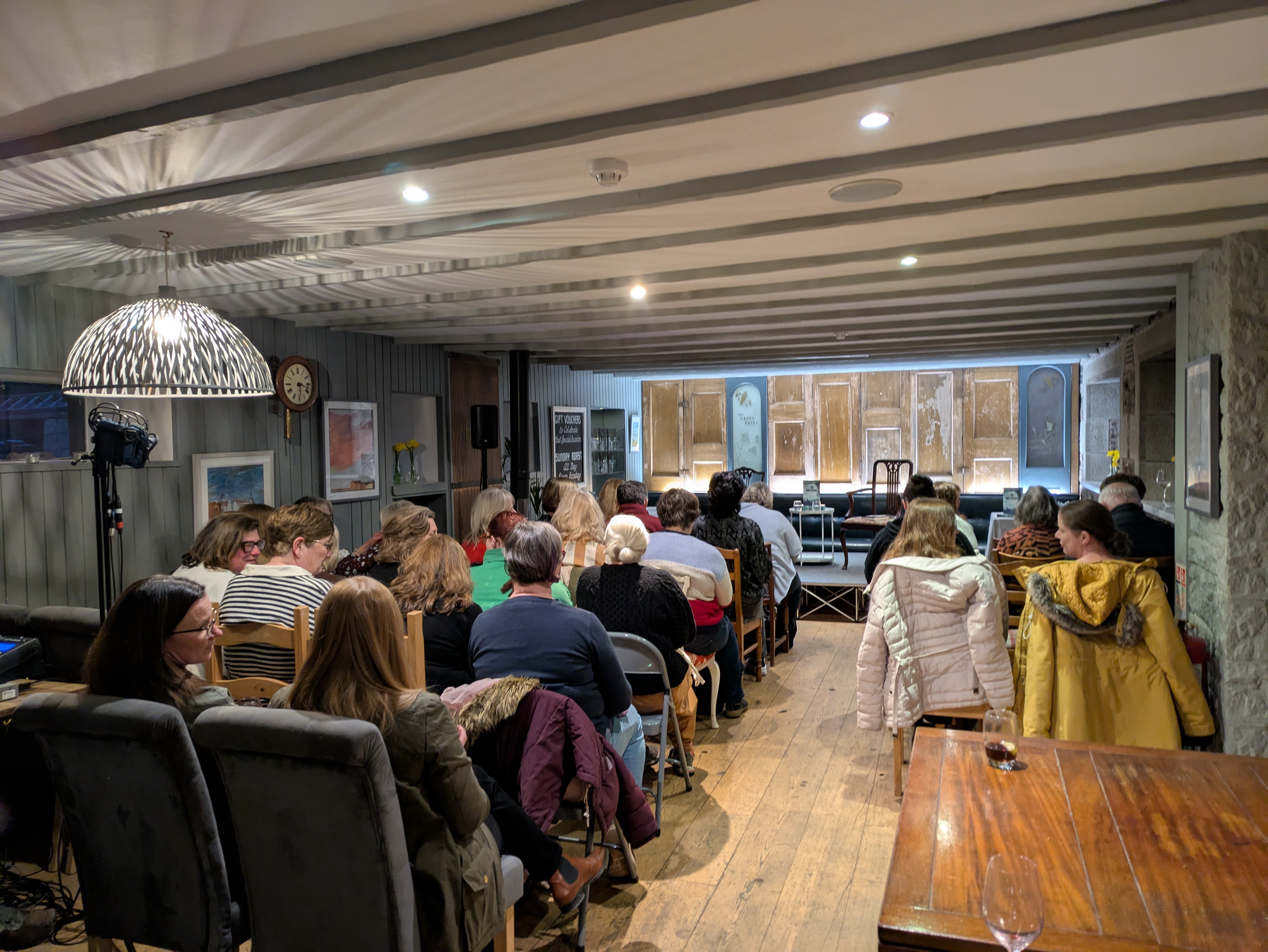
Finally, a bigger event in East Linton hosted by Night Owl Books, and chaired by the manager Rebecca.

The crowd begins to gather...


Well over 30 people came to this, and it never ceases to amaze me that people would be willing to give up their time to come and hear me ramble on about my book. Again, the converstation was wide-ranging, I got to really dig into aspects of the novel and the whole journey to publication, and the questions at the end were great. I signed loads of books afterwards, including from someone who had already read the novel twice (!) and who said it was inspiring them to write their own fiction. That is high praise indeed, and really humbling. This was a great event, and Rebecca is to be commended for running these so well.

I don't have anything else lined up events-wise at the moment. I was hoping to get offered something from the Edinburgh International Book Festival, but given their funding woes I think I might have to wait for next year. In any case, I've surprised myself by enjoying these, once the initial nerves are overcome. In the run-up to the book launch in February I would idly daydream about changing my name and getting a job in the Hebrides on a fishing trawler rather than go through the nightmare terror of a public speaking event, but once they're underway they can be incredibly rewarding. It turns out I might be a secret egomaniac, and I quite like having a captive audience forced to listen to me wax lyrical about my own work. Who would have thought?


Friday, 21 March 2025

But Who is Stronger Than Death? Ted Hughes, evidently.


This hardback edition of the Collected Poems of Ted Hughes is my most treasured possession. I was given it as a leaving present by my friends and colleagues at the Notting Hill branch of Waterstones in London, all the way back in October 2003. I’d worked there for only a year or so, but it was the among the best jobs I’ve ever had, and it was a sad day when I learned recently that the branch is now defunct.


 As can be seen above, everyone signed the endpapers for me, and to this day I can remember them all exactly. One of the many drawbacks of moving around a lot when you’re younger is that you end to replace one group of friends with another, and it becomes harder to stay in touch with the people you leave behind. Anyway, to Ian, Gilles, Mette, Serene, Freddie and (especially) Kirstin – I hope you’re all doing well, wherever you are.

This collected volume had just been published that year, and although I’d been a Ted Hughes obsessive for about a decade there was much in it that I hadn’t read before. I can’t remember the exact moment I became aware of Hughes, but it was almost certainly through reading Sylvia Plath when I was a teenager. (Although now I think of it, I had read his superb children’s book The Iron Man when I was about seven, so Hughes is probably the writer with whom I’ve had the longest relationship.) There’s an inevitable, prurient fascination in the darkness and tragedy that surrounds Hughes’s life, and we may as well get it out of the way here. As everyone knows, Sylvia Plath committed suicide in 1963, and Hughes was blamed for it for decades. His lover Assia Wevill then committed suicide in 1969, in identical circumstances to Plath, killing their four year-old daughter Shura before taking her own life. The idea that Hughes was some patriarchal monster forcing these women to kill themselves was common currency in some critical circles for decades, but I think it was definitively cut off by the publication of his late collection Birthday Letters in 1998, and by the publication of his selected letters in 2007. All of the above is biography and gossip, not literature, although it’s clear the colossal emotional pain Hughes suffered from these tragedies fed into his darkest writings in the late 1960s and 1970s.

Seamus Heaney called Hughes ‘a guardian spirit of the land and the language,’ a poet who ‘internalised the historical crises of the British nation and the ecological crises of planet earth’, and it was this completeness of poetic vision that first drew me to his work; his vivid strangeness, the perspective on the natural world that was somehow both tender and fierce, alive to violence and death at the same time as seeing those struggles as inherent and valuable parts of a greater and eternal whole. I suspect most readers of Hughes find initial value in his animal poems and his poetry of the natural world, the early lyrics from his first collections The Hawk in the Rain and Lupercal. Poems like the much-anthologised ‘The Thought-Fox’ and ‘The Jaguar’, or ‘Pike’ and ‘Wind’ show this early gift for embodiment and a richly unsentimental sympathy. Sometimes it feels as if this perspective is more empathetic than sympathetic, as though it’s coming from within the natural world rather than being imposed on it from outside. Alice Oswald, the clearest inheritor of Hughes’s mantle, describes him as less of a natural poet than a preternatural one, his animals emerging from some dark, metamorphic space, changed by his knowledge of the deep roots of mythology and folklore. The startling adjectives and adverbs imbue these creatures with shocking strangeness; they are estranged from our common, desultory understanding of them. The jaguar in his cage ‘[…] hurrying enraged/Through prison darkness after the drills of his eyes/On a short fierce fuse’. A sparrow ‘whets his stub weapon’ on a branch in ‘Sunday Evening’, and in ‘Thrushes’ the birds seem less like humble garden visitors than heralds of cataclysm: ‘Terrifying are the attent sleek thrushes on the lawn,/More coiled steel than living’.

It would be a mistake to see the Hughesian eye in this period turned only to the animal life that surrounded him though. Contemporary politics was of no interest, but Hughes had an unusually intense identification with the bloody horrors and sacrifices of the First World War, which puts him in much closer communion with the war poets Sigfried Sassoon, Wilfred Owen, David Jones and Robert Graves (especially the last two) than you might think. Hughes’s father and uncle were both veterans of that war, and he often spoke of how the Yorkshire valleys where he grew up, well into the 1950s, still seemed in deep mourning for the local boys who had been killed. Poems like ‘Bayonet Charge’ and ‘Six Young Men’ are superb imaginative engagements with battle and human suffering, exploring with anger and compassion the experiences of men like his father.

The prevalence of mythology and folklore in Hughes’s poetry began to intensify into the late 1960s. His 1967 collection Wodwo initialled the change, a combination of poetry and short stories that seems formally inventive for the period. (‘Rain Horse’, later reprinted in the story collection Difficulties of a Bridegroom, is one of the best short stories ever written.) It was 1970’s Crow: From the Life and Songs of the Crow that solidified Hughes’s deepening and incredibly dark obsession with the lineaments of folk tales and myth, something that continued for much of the decade that followed. The sequence is an unstable text, with Hughes adding and subtracting individual poems from it, hiving some of them off to other collections, or keeping handfuls sequestered in either limited edition pamphlets or uncollected altogether. It was intended to be an epic folk-tale, with Crow as a trickster figure, cowardly and selfish, created by God in some horrified impulse; ‘a black rainbow/Bent in emptiness’, ‘Screaming for Blood/Grubs, crusts/Anything’. Creation itself is a horror, a roiling arena of sexual depravity and bloodshed, investigated by Crow in all his mocking curiosity. This solidification (some would say ossification) of Hughes’s interests and themes  from a natural to a mythological world has an attendant loosening of form. The Crow poems are not so much free verse as a destruction of poetic form and a rough stitching of it back together, in lines and stanzas of savage violence, black irony and bitter sarcasm. The poems are difficult, ugly in places, thrilling, disturbing – ripe for parody in many ways, as only the most stylistically distinct work can be. Hughes was to stick with this more abrasive style in works like Cave Birds, inspired by the grotesque, caricatural work of his friend, the artist Leonard Baskin, and in what might be the strangest book ever written; 1977’s Gaudete. A loosely versified narrative, Gaudete recounts the abduction of an Anglican clergyman into the underworld and his replacement by a duplicate changeling crafted from a rotten tree stump, who then goes on to minister to his parishioners in a distinctly sexual manner. To say that by this point we’re a far cry from the intimate natural histories of The Hawk in the Rain would be something of an understatement.

Hughes’s work slowly returned to a richer and more intimate engagement with his subjects though, the apocalyptic and alchemical interests becoming more restrained (as in his 1989 collection Wolfwatching), and the natural world explored and recreated through more a tender, caressing observation. ‘A Cranefly in September’ is a work of both intimately close detail and visionary transformation, the titular insect ‘blundering with long strides, long reachings’ as it traverses a patch of grass, the poet’s eye imbuing it with a greater valence as he notes ‘Her jointed bamboo fuselage’ and ‘the simple colourless church windows of her wings’. In the end, after adorning the insect with a kaleidoscope of similes and images, and personalising it as ‘her’, the cranefly must also be seen as an evolved creature of matter and chemicals fulfilling its instinctual function: ‘The calculus of glucose and chitin inadequate/To plot her through the infinities of the stems.’

Remains of Elmet and River return Hughes to the landscapes of his childhood, while Season Songs, a collection written ‘in hearing’ of children, and Moortown Diary reflect his growing involvement with farming and agriculture. Moortown Diary is surely one of the greatest collections about man’s engagement with the land ever written, an intimate portrait of the bloody realities of farming life that nevertheless finds a strange calm and equipoise in the rough business of dehorning cattle, shearing sheep, and overseeing the birth of calves, ‘Collapsed wet-fresh from the womb’. It is about man’s often vexed relationship not with landscape, but the land; a needed thing, obdurate and stubborn, a dishcloth that must be wrung out for the very last drop of human sustenance.

This balance and contrast between the shamanic Hughes and the Wordsworthian keeper of the land meant that he is probably the only major poet since Tennyson to have made a success of the Laureateship, when he was appointed in 1984. He spoke of the position in explicitly shamanic terms; if the crown is the symbol of the unity of the tribe, then the Laureate can represent and give voice to the spiritual unity of that tribe. Unpromising occasions like the christening of Prince Harry produced poems like ‘Rain-Charm for the Duchy’, a rushing, water-soaked work that flows through the rivers and streams that pour across Devon, an incantatory roll-call of river names that seems to make an implicit, Arthurian connection between the fertility of the crown and the fertility of the land. In a letter from 1979, Hughes noted that all creative work to him was ‘a conjuration, a ritual summoning of all energies associated with the subject matter’.

Two more great works were to follow before his death in 1998. The nourishing, imaginative topography of myth hadn’t left him, and in Tales From Ovid Hughes turned to one of the original sources, adapting Ovid’s Metamorphoses into rich, indecorous poems of an overwhelming blank verse that feels hewn out of stone. Here capricious gods wield infinite power, the transformations of man to animal a metamorphosis of unrivalled horror. Even Martin Amis (a natural Philip Larkin man more than a Ted Hughes man) called the book ‘masterful.’ It was 1998’s Birthday Letters though that sealed the poetic career and capped this later flowering of genius. It was the first time he had engaged in his work with the suicide of Sylvia Plath, and it was clear from this collection of stunned conversations, unflinching and interrogatory, that he had been working on it since her death in 1963. The book was a colossal bestseller, but even if people were reading it for prurient reasons they could not have been unaffected by the emotional power of Hughes’s verse. It won every prize going, and as if to underline its significance as his last word on the matter, he died of cancer only nine months later. Typically, he suspected he had contracted the disease because he had spent too much time writing prose, instead of poetry.

Of all his works Birthday Letters has the most emotional resonance for me. I’ve always been deeply suspicious of the shallow, tote-bag slogan idea that literature can be ‘healing’, or that it has some magical analgesic effect (as if a d headache can be shifted by a dose of Shakespeare instead of two paracetamol and a glass of water), but Birthday Letters was one of the only books I could read in the aftermath of my mother’s death in 2012. I would get up early every day that summer and sit in the garden at my father’s house, drinking a coffee and reading and re-reading this book, unable to let it go. It was an anchor in many ways, a lifejacket. It felt like Hughes was invocating his grief directly into my heart, and that this shared sorrow was somehow both deepening my own grief and making it more bearable. The poems are concentrated moments, flickers of disbelief and understanding, roving attempts to find meaning in detail and significance in the half-remembered and the painfully exact. The language is sometimes plain, sometimes achingly beautiful. On his first meeting with Plath, in ‘St Botolph’s’, accompanied by another lover: ‘Falcon Yard:/Girl-friend like a loaded crossbow’, or in the starkly titled ‘Error’: ‘I brought you to Devon. I brought you into my dreamland./I sleepwalked you/Into my land of totems.’ The collection gives a retrospective understanding to Hughes’s entire body of work, that he was in many ways trying to exorcise deaths that he felt responsible for. In the folkloric mode that he made his own, the condemned man must descend into the underworld in order to be transformed. Here, Hughes is plummeting into his memories, his guilt and grief. He is bringing back the brightest ore, and like a blacksmith is hammering it into astonishing new shapes.

The idea of having a ‘favourite writer’ is a bit reductive, a Top Trumps approach to literature that denies what makes any writer most engaging. Different writers, different books, provide different experiences, and it’s the collective, multivalent voice that most attracts. I could no more take only one book to a desert island than I could take nothing, but if I was forced to choose then perhaps this hardback of Ted Hughes’s collected poems would come with me. He is the complete writer in terms of how much he has infiltrated my imagination and affected the way I view the world, both outside and inside. He is not just a poet or a critic, but a vehicle for the English language, a storehouse of all its richness and power, recharged from the abyssal wellsprings of myth and folklore. There’s something almost autochthonous about him, and his voice is woven through all the thickets of my obsessions and interests. Like Martin Amis (his antithesis, in many ways), he writes with originality, euphony and force of expression; for me, the triumvirate of aesthetic virtues. Michael Hofmann, another poet and critic I revere, boldly said that Hughes was the greatest English poet since Shakespeare. Appropriately, the one book of his I haven’t read is his incredibly idiosyncratic 1992 critical study, Shakespeare and the Goddess of Complete Being. I plan to read it this summer, and perhaps then, once I’ve absorbed everything by him, I’ll move on from my Ted Hughes obsession. But I suspect not.

‘There is no better way to know us/Than as two wolves, come separately to a wood.’

Friday, 14 February 2025

Publication day, and a book launch

 Thursday 13th February 2025, a day that shall live in infamy...

Yesterday my debut novel 'The Unrecovered' was published, and we had the book launch at Golden Hare Books in Stockbridge, Edinburgh. (A short informative sentence that encapsulates pretty much everything I've been working towards for about 25 years.)

In the afternoon my editor Alison took me around various bookshops to sign stock (which made me feel like a proper writer) and then in the early evening we headed to Golden Hare.

Mary Paulson-Ellis was the best chair I could have hoped for, an incredibly astute reader who steered the conversation into very interesting terrain. It's a strange thing to discuss your work like this, because it forces you to examine much of what is either inchoate or intuitive in your writing, teasing out themes or correspondences of which you might not have been consciously aware. I also did a short reading and fielded questions from the audience, and the hour was over much faster than I thought it would be. It was great to catch up with old friends and to see the novel firmly launched into the uncertain seas of literature. And then to start drinking heavily afterwards.

I have heard other writers speak of a strange sense of anti-climax once a book has finally been published, but it definitely feels like a point of culmination for me, having spent so long trying to get here. Reviews and sales and so on are all out of my hands now, and not really worth worrying about (although obviously I hope for colossal critical and commercial success...) The reviews so far have been great and hopefully there are more to come, but the book is the thing. It's out there now, for people to spot on a table or a shelf in the bookshops, to read if they choose, or to pass over in favour of something else. I certainly hope people take a chance on it.


Wednesday, 1 January 2025

2025: a look ahead

 2024 is over, and a new year is upon us. I thought I’d write a brief overview of what I have planned for 2025, with the proviso that nothing in writing ever goes entirely to plan, and that projects I might confidently summarise here could easily be dropped in favour of anything that announces itself more forcefully to my mind. With that caveat in place…

The main thing of course will be the publication of my debut novel, The Unrecovered, on 13th February. The book launch will be at Edinburgh’s Golden Hare Books on that day, chaired (in something of a coup!) by Mary Paulson-Ellis.

Tickets for the launch, redeemable against a copy of the book, can be ordered here:

https://goldenharebooks.com/products/the-unrecovered-launch-event-with-richard-strachan-thursday-13th-february-2025

Pre-orders for signed and dedicated copies are available here:

https://goldenharebooks.com/products/the-unrecovered-by-richard-strachan-signed-and-dedicated-pre-order-13th-february-2025

And here’s a link to various other places where it can be preordered: https://linktr.ee/richstrach

It goes without saying that I’ve never had a book launch before, although I’ve been to plenty of them in my time. To say that the prospect fills me with raw terror would be an understatement, but I’m just pushing all the anxieties to one side for the moment. Hopefully it can be something I’ll actually enjoy once it’s up and running. Either way, I will finally have a proper novel out there in the wild.


Other than that, I’ll have the general round of edits to do on my second novel. I submitted the third draft in mid-December, and no doubt there will be lots of work to do on it during the year to get it into shape. It’s changed quite a lot since the first draft, but I’m comfortable with where it sits now.

I’ll also be trying to finish the first draft of a third novel, the final volume of a tentative thematic trilogy all about war, British history, archaeology, landscape and myth. I made a pretty good start on this in the second half of 2024, and hopefully I can get this into some vaguely completed form by summer 2025. After that there will be the usual rounds of intensely self-critical editing and redrafting etc before I can submit it.

Assuming that all goes to plan (see above), I want to spend the second half of 2025 looking over and redrafting a novella and some short stories for a possible collection. Most of the short stories have been published before, in various magazines, but the novella is something I’ve never managed to place anywhere. I’m intensely proud of it all the same, it’s like the distilled essence of every subject and style I care about the most. It was around 60,000 words the last time I checked, and ideally I’d get it down to about 35,000. The collection would be a bit more formally experimental than the novels I’m currently writing; less character and plot, more style and imagery.

On top of that (and already this seems a ridiculous amount to try and pack into one year), I want to start some very early sketches and notes towards a short novel I’ve had percolating in my head for a while. Again, this would be a more formally experimental piece, but of everything I can dimly perceive in the future it’s the work that’s most insistently demanding my attention. I wouldn’t start work on it properly until 2026, assuming my interest in it doesn’t flag, but I want to start outlining and researching and thinking about it when I’ve got the time.


Of course, none of this takes into consideration the usual unexpected life-events that always throw your plans off-track, and I’ve got a few events pencilled-in around the publication of The Unrecovered which will take up some time. But if I can get into a pretty steady work rate, I think much of this will be achievable. I’ll look back over it on New Year’s Day 2026, and that hollow laughter you’ll hear will be me contemptuously scorning my optimism…

Friday, 8 November 2024

Book review: Through the Hedgerow, by Jonathan Rowe


Apart from a brief period with Warhammer Fantasy Roleplay when I was about thirteen, and a briefer period trying to interest my children in Dungeons & Dragons, I’ve never been one for actually playing RPGs. They take too long, it’s hard to find people who get exactly the same things from them that you do, and more so than any other tabletop game I find them policed by a sometimes insurmountable conceptual barrier. Entering into an RPG campaign requires you to make not just an imaginative leap, but a leap past your own sense of embarrassment and self-consciousness. In the same way a great actor has surmount their sense of self in order to inhabit their role, a roleplayer has to disassociate themselves from the long social and cultural conditioning that says it’s somehow childish for an adult to pretend to be somebody else. All this is my failing, I have to stress. There’s a level of abstraction in other tabletop games (wargames, board games, card games etc) that makes it easier for me to engage with them. Roleplayers, the tabletop elite, are essentially not my tribe.

Saying that, I have long loved reading RPG rulebooks, and they can be a real source of inspiration and enchantment for me. I love the way RPG writers develop a world from the ground up, and the way the mechanics of their games represent how that world is to be interacted with. In this article from about ten years ago, the writer Damien Walter noted how RPGs can be a form of ‘ergodic literature’, the type of texts that make specific demands on the reader and upend the conventional physics of reading. Obvious examples would include David Foster Wallace’s Infinite Jest, with its constant flicking back and forth between text and endnotes, or Mark Z. Danielewski’s House of Leaves, with its footnotes and handwritten inserts, its finicky layout and editorial asides. Perhaps the greatest example would be BS Johnson’s The Unfortunates, a book that the reader must assemble for herself from a box of separate unbound sections. RPGs, if we’re following this example, provide the reader with a non-sequential system of environmental detail, societal background, character types and material culture. A world has been deconstructed into its constituent parts and themes, and it’s up to the reader to blend them together in a way that makes personal sense to them. Although provided with the same information, no two readers will assemble that information in the same way.

All of which is a long preamble to explain why the roleplaying game Through the Hedgerow has had such an effect on me recently, and why I thought it would be worth reviewing here. Written by Jonathan Rowe, with wonderfully evocative illustrations by Peter Johnston, the book is published by Osprey as part of its Osprey Games division. Billed as ‘A Roleplaying Game of Rustic Fantasy’, Rowe’s work here weaves together several threads that all exert a significant pull on very specific parts of my imagination. In fact, as soon as I read the word ‘hedgerow’ in the title, I not only knew this book would be for me, but that I could make a reasonable guess at the kind of tonal atmosphere Rowe was aiming for.


In summary, Through the Hedgerow is set in four separate era of British history. (I would actually say this is specifically English history, and a game that deals with English themes, but that’s perhaps a separate discussion.) These are: the Age of Swords (the Dark Ages and the Viking invasions); the Age of Plagues (the 17th century and the civil wars); the Age of Steel (the industrial Victorian era); and the Age of Thunder (the Second World War). Players create characters based on specific types, known as ‘Gentries.’ These can include more conventional figures like Hodkins (highwaymen, adventurers), Heathen Clerks (priests and priestesses who follow Heathen Saints) or Motleys (morris dancers, wandering vagabonds). It can also include more esoteric figures, like Tomnoddins (humanoid spider-creatures), Flayboglins (animate scarecrows) or Ouzels (bird-headed aristocrats). Plunged into a hidden world where the Light battles eternally against the Dark, the players are plucked from their home age and have to negotiate the maze-like hedgerow, until they arrive in one of these four Ages of England, where they will have to investigate and defeat the machinations of the Dark. Rowe is explicit here that, unlike other RPGs, his game does not privilege violence; player characters are on the whole not warriors who solve every problem with a sword. The missions they undertake might involve rescuing a village woman accused of witchcraft in the 17th century, or recovering a sacred relic stolen from a church by a Viking warband. The game stresses the importance of investigating, healing and restoring balance. The characters are supposed to re-establish a sense of equilibrium between the Light and the Dark, as much as exalt one over the other.


I’m not qualified here to talk about the mechanics of the game, but Rowe has clearly tried to move them away from the standard Dungeons & Dragons-inspired system of player stats, checks and bonuses, and he discusses this at length on his blog, Fen Orc (which is well worth a read for his ideas about RPGs more generally). What I’m most interested in here is the source material and the inspirations that have fed into this game, which Rowe details in the appendix and on his blog. Most clearly, Through the Hedgerow draws on Susan Cooper’s superb series of children’s books, The Dark is Rising sequence, as well as on Alan Garner’s approach to time and deep history. Rowe also notes the influence of 1970s TV serials, like Doctor Who, Children of the Stones, Worzel Gummidge and Catweazle. I would also say that there are links to a whole host of texts in the ‘British Weird’ or folk horror tradition, from the holy cinematic trinity of The Wicker Man, Blood on Satan’s Claw and Witchfinder General, to TV plays like Penda’s Fen and Nigel Kneale’s The Stone Tape. Even the haunting 2000AD comics series, The Journal of Luke Kirby, is drawing from a similar well. The Four Ages of the game are stations of the secular cross on which Britain has hung much of its quasi-mythological understanding of itself in recent years, from the reign of Alfred the Great to the chaos of the civil wars, or from Victorian materialism to the embattled siege of the Second World War. The game draws on archetypes or cultural touchstones buried deep in the British psyche, from the witch hunter to the wounded Battle of Britain pilot, the wandering wise man, the holy fool haunting the hedgerows. If the figure of Cole Hawlings in The Box of Delights, a magical Punch & Judy man engaged in some cryptic conflict between the Old and the New Magic, tugs on your imagination in any way, then Through the Hedgerow is the game for you.


Above all, I think this book is about the liminality of the countryside, the edgelands between the town and the open fields beyond. It conjures up a mysterious world of briar patches and bramble, of the mist threaded through the stubble of a wheatfield while crows gather in the hawthorn. It’s part of an imaginative, almost spiritual cultural response that sits adjacent to Mackenzie Crook’s Detectorists or the music ofJohnny Flynn, and although it’s explicitly a fantasy game it has as much to do with the writings of Melissa Harrison and Robert Macfarlane as Susan Cooper or Alan Garner. I wouldn’t go so far as to say this is a game or a world for environmentalists, but its emphasis on the rural and where the rural overlaps with the urban, does give it a certain political salience. The ‘folklore turn’ of much modern literary culture is arguably drawing on ideas of rewilding and environmental renewal, even on Derrida’s ideas of Hauntology (‘Re-enchantment is Resistance’, as Hookland says …), and Through the Hedgerow is embedded in that folk horror tradition. Beyond politics though, it has captured the sense that even though we are only passing through the landscape, our ephemerality can still leave a significant trace upon it, and that there is enchantment in the corner of your eye if you could only see it. It’s something glimpsed on a patch of waste ground on Bonfire Night, or from a train window as you pass through summer fields at dusk. It’s there in the drift of dead leaves on a lonely autumn afternoon, or the call of a raven on the edge of a sodden moor. This is a deeply imaginative piece of work, and it suggests you only need to make a small leap of the imagination to experience it for yourself.

If not exactly a work of fiction then, Through the Hedgerow has still provided me with what fiction does best; it has altered, to the smallest degree, how I look at the world. My lunchtime walks along the old railway tracks near where I live, with the autumn trees hanging over the path, now take on a new resonance. The call of a tawny owl at dusk from the cemetery along the road carries an extra thrill. A fox slipping through a back garden is an emissary of something larger and more mysterious. The hedgerow is thinner than it looks; who knows what might lie on the other side?


(Through the Hedgerow, written by Jonathan Rowe, with illustrations by Peter Johnston, is published by Osprey Games, £25, pp272)


Friday, 1 November 2024

Stage Two, and a trip to London

 On Wednesday (30th October) I was down in London at the Raven Books showcase event, in the suitably evocative surroundings of the Gothic Bar in the St Pancras Hotel. I was there to pitch The Unrecovered to an audience of booksellers and books media, alongside the writers Nicola Whyte, Holly Watt, Rosie Andrews and Stuart Turton, who were all there to pitch their books too. There was a brief Q&A with my editor Alison, and then there was plenty of time afterwards to chat to people and sample the free booze. More importantly, it was a chance to meet people from the Raven Books and wider Bloomsbury team who I've been emailing for months now, but hadn't actually seen in person yet. Thanks in particular to Alison, Emily, Abi and Therese for making everything far more enjoyable than I'd hoped, and less stressful than I'd feared!

This kind of thing very much doesn't come naturally to me, and it was a step up from the proof drop experience a couple of months ago. I truly hate the cliche of the closeted neurotic writer, but when you spend a lot of your time on your own, it can be quite a strain to force yourself outwards again and dig deep into an atrophied fund of small talk. It's important to do so though; publishing is a business built on the relationships developed between writers, agents, editors, marketing professionals, booksellers and reviewers, and they're relationships that need to be cultivated. Plus, when a publisher offers to put you up in a nice hotel and buy you dinner, any writer worth their salt will automatically say yes, or I don't really know what they're doing in this business.

I had a meeting with my editor beforehand as well, to go over the next round of edits on my second novel. Everything here is on track, so I'll be getting back to work on it over November/December. This was the first time I've been to Bloomsbury's beautiful, labyrinthine offices, an opportunity worth the trip in itself. 

Next up, I've got 1000 sheets of endpapers for the independent bookshop edition of The Unrecovered to sign, which I'm hoping to get done over the next couple of weeks. I haven't quite figured out my approach to this yet, and I've no idea what my signature's going to look like after 999 previous attempts, but I'm hoping to get about 200 signed a day. Perhaps that's optimisitic, but we'll see ... 

Wednesday, 28 August 2024

Stage One, and a lot of shoe leather

 For the last couple of days I've been going around various bookshops in Edinburgh and the Scottish Borders, escorted by the incredibly hard-working David (the Bloomsbury sales manager (or as we used to know them in the bookselling trade, the 'rep')), handing over proof copies of my novel The Unrecovered. Day One saw us taking a long drive to St Boswalls and the wonderful Mainstreet Trading, then on to Biggar and Atkinson Pryce, then up to St Andrews and Toppings & Co., then to Linlithgow and Far From the Madding Crowd. Day Two was all the Edinburgh shops, including Argonaut, the Edinburgh Bookshop, Toppings, Waterstones, the Portobello Bookshop, Lighthouse and Blackwells. I was disappointed however to see only one quality bookshop dog (at Lighthouse Books). [Note: the only reason Edinburgh's greatest bookshop, Golden Hare, was left out of the list is because I live with the manager and it seemed a redundant stop on the itinery. I add this only because I wouldn't want the casual reader to think I had an obscure grudge against them.]

The 'proof drop' is something that's developed over the years since I last worked in a bookshop, but the idea is to personally introduce both yourself and your novel to the people who are actually going to be putting it on their shelves and (hopefully) selling the thing. It tends to be more for debut writers, and it's a strange business that doesn't quite come naturally to me. Once I'd eased into it after the first couple of visits I found it strangely enjoyable though. It's actually quite pleasant meeting the booksellers, drinking their tea and eating their biscuits (and bribing them with biscuits of your own), and getting a chance to talk about your book. I quickly developed a short pitch to explain what the novel was about, although by the end of the second day I was fairly sure I never wanted to hear about another 'gothic-historical novel set towards the end of the First World War' again, so who knows what the booksellers thought. David also took what felt like hundeds of photographs of me awkwardly posing outside these bookshops, wielding the proof like a shield, and I've promised myself not to look at them if/when they go up on Instagram.

Apart from providing a little glimpse behind the curtain of how all this works, which wasn't unexpected given how long I worked in bookselling and publishing myself, it seriously underlined for me how much basic pavement-pounding and shoe leather goes into getting a book into a reader's hand. Writing the novel began to seem like the easy part; the hard part starts when sales and marketing roll up their sleeves and get cracking.

So, Stage One is complete: the proofs have gone out, and supportive quotes are being gathered (which deserves a blog post of its own). Next up is the Raven Books showcase in London at the end of October, when I'll have to talk about the novel at scale...

Saturday, 6 July 2024

Summer writing

 Last week I had a Zoom meeting with my editor about the draft of my second novel, by the end of which both of us were on the same page about what needs to be done for the next draft. This will take me through the summer and into September, after which the next book should be well on track.

Because I tend to obsessively go over any piece of work again and again before I submit it, any editorial feedback can sometimes feel quite destabilising. It's one of the most essential parts of the process though - you need that second set of eyes to look at your story and point out where the pace flags, where some characters need to be brought up in the mix and others turned down, or where themes need further refining. For me, the flipside of obsessively polishing a novel before submitting it is that as soon as I get feedback I can instantly veer in the other direction, ruthlessly cutting out swathes of text that no longer seem essential. It's a fine balance, but that process of redrafting can also be one of the most pleasurable in this whole strange business of writing and publishing a novel. Getting into the meat of the thing, seeing how the bones and the nervous system all fit together, makes you feel like some feverish Dr Frankenstein. At the end of it all, you might wince when you notice all the sutures and joins, but at least the creature lives.

So, as the summer begins, I have in front of me a print-out of the typescript, and I look on it with a cold and merciless heart. The body is before me; let us see if I can give it life.

Wednesday, 26 June 2024

Two years later ...

 Well, almost exactly two years since my last post, and an awful lot has changed. I have a literary agent, a two-book deal with a publisher, and my first novel is due to be published in February 2025. This will be 'The Unrecovered', a gothic-historical novel set during the last months of the First World War, in a hospital for recuperating soldiers just outside Edinburgh.

In the run-up to publication I'll be trying to update this site a lot more, not only to try and rustle up a few more sales, but partly to attempt some insights into the whole publication process for anyone who might be staring down that particular barrel themselves. I was always taken with Neil Gaiman's early online journal, more than twenty years ago now, where he documented the experience of copy-editing and checking the proofs of American Gods, and seeing the early reading copies go out into the wild in search of welcome encomia.* I'd like to try something similar, so that the whole blogging experience feels less of a drag, or something artificial. A running diary or a place where I can set down related thoughts on this strange business might tempt me into keeping it up to date, rather than letting it fade away as these things so often do. (Or disappearing to Substack in an attempt to monetise all this ...)

Anyway, more to follow in good time ... 


* Note: I wrote this before the allegations about Gaiman emerged. I thought about going back into this blog post and deleting the reference, but in the interests of historical accuracy thought it would be more honest to leave it where it stands.

Saturday, 25 June 2022

Tashala's Hair

 My story 'Tashala's Hair' appeared in Metaphorosis Magazine this month, as I mentioned in the previous post, and the podcast version of the story has just been uploaded. Narrated by Matt Gomez, it can be found here.

Wednesday, 22 June 2022

A new beginning ...

 A new blog for a new ... 

Well, not a new much of anything, to be honest. I felt that the old WordPress blog had become both so cluttered and so uneventful that I wanted to start from scratch with something different, and so I've set up this Blogger account with the hope that it will get me back to regularly blogging again. At the very least, it can be a space where I round-up writing news, of which I should have a couple of things to say shortly.

Anyway, recent publications include my story 'Tashala's Hair' in the June 2022 issue of Metaphorosis. I lean a bit more into the fantasy side of things with this one, and there should even be a podcast version of it available soon. I'll post the link when I have it.